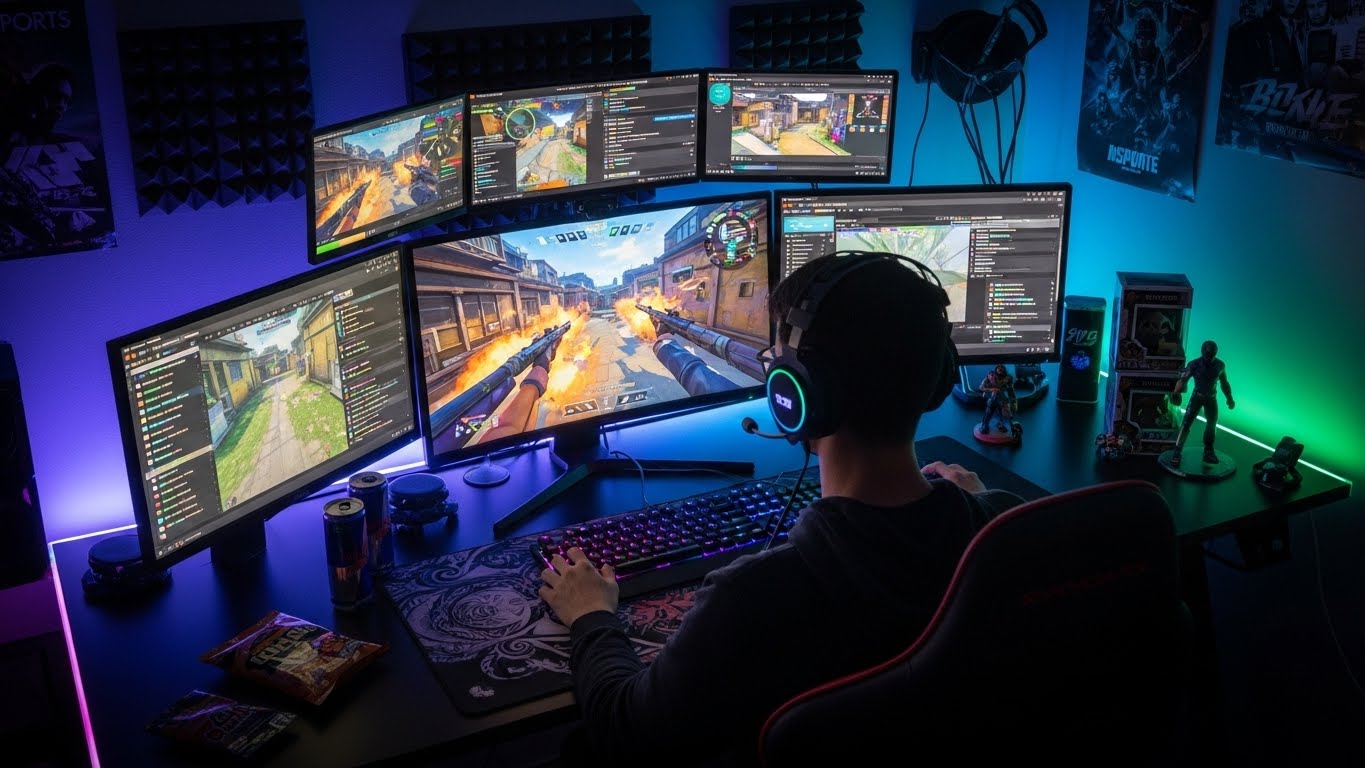

Gaming has transformed from a niche hobby to a global entertainment phenomenon, evolving at a pace that many could not have anticipated a few decades ago. From the humble beginnings of pixelated characters on a screen to fully immersive virtual worlds, the gaming industry has undergone dramatic shifts in technology, storytelling, and community engagement. Today, gaming is no longer just a pastime; it’s a culture, a profession, and for many, a way of life.
In this blog post, we will explore the journey of gaming, its impact on society, the technological advancements that have shaped its future, and the role it plays in the lives of millions around the world.
The Early Days of Gaming: A Simple Start
The origins of video gaming can be traced back to the 1950s and 1960s when the first rudimentary games were developed. These early games were often the product of academic curiosity and were displayed on large, clunky machines that only a few could access. Games like Tennis for Two (1958) and Spacewar! (1962) laid the groundwork for the video game industry.
It wasn’t until the 1970s that gaming began to gain mainstream popularity. The release of arcade classics like Pong in 1972 signaled the beginning of the gaming revolution. Pong was simple yet captivating, consisting of two paddles and a bouncing ball, but it was addictive enough to keep players coming back for more. The arcade gaming era continued into the 1980s with iconic titles like Pac-Man, Donkey Kong, and Space Invaders. These games, while basic by today’s standards, captured the imagination of millions.
Consoles like the Atari 2600 brought gaming into homes, but the real leap forward came with the introduction of more sophisticated hardware and the development of home computer systems.
The Rise of Consoles and the Golden Age of Gaming
The late 1980s and early 1990s marked the golden age of gaming. Companies like Nintendo, Sega, and Sony became household names as they introduced their own gaming consoles. The Nintendo Entertainment System (NES), released in 1985, revolutionized gaming by providing high-quality games like Super Mario Bros., The Legend of Zelda, and Metroid. These titles were among the first to showcase the storytelling potential of video games, drawing players into fantastical worlds filled with vibrant characters and complex narratives.
Sega’s Genesis and the Sony PlayStation, released in the early 1990s, brought even more innovation. The PlayStation, in particular, marked the beginning of 3D gaming, with titles like Final Fantasy VII and Gran Turismo pushing the boundaries of graphics and gameplay. These games featured sprawling open worlds, intricate plots, and deep character development, setting the stage for the more narrative-driven games of the future.
The 1990s also saw the rise of PC gaming, with titles like Doom and Warcraft leading the way. These games brought online multiplayer functionality into the mainstream, allowing players to compete with others across the globe, a precursor to the modern world of eSports and online gaming communities.
Technological Advancements: Pushing the Boundaries of Gaming
As technology continued to improve, so did the gaming experience. The 2000s saw the release of consoles with more powerful hardware and cutting-edge graphics. The PlayStation 2, Xbox, and Nintendo GameCube, for instance, all offered better graphics, faster processors, and more immersive gameplay than ever before. But it was the introduction of high-definition gaming in the mid-2000s that truly elevated the industry to new heights.
With the PlayStation 3, Xbox 360, and the rise of gaming PCs, graphics became increasingly realistic. Titles like Halo 3, The Elder Scrolls V: Skyrim, and Grand Theft Auto V pushed the boundaries of what was possible, creating vast, open-world environments with incredible attention to detail. The arrival of HD graphics gave games a cinematic quality, allowing players to become fully immersed in digital worlds that felt more like real life than ever before.
Moreover, advancements in AI (artificial intelligence) allowed for deeper, more complex game mechanics. The non-playable characters (NPCs) in games became more reactive and sophisticated, creating more dynamic and unpredictable gameplay experiences. From smart enemies that adapt to a player’s style of play to fully interactive environments, AI began to play a crucial role in making games feel more lifelike.
The Advent of Online Gaming and Social Interaction
One of the biggest changes in the gaming landscape has been the shift toward online gaming. While multiplayer games existed in the 1990s, it was the broadband internet revolution in the early 2000s that made online gaming mainstream. The launch of Xbox Live in 2002 and PlayStation Network in 2006 allowed gamers to connect with one another on a global scale, making online play a central part of the gaming experience.
Games like World of Warcraft, Call of Duty, and League of Legends gave players the chance to team up (or compete) with others from around the world, fostering the creation of global gaming communities. Online gaming also led to the rise of live-streaming platforms like Twitch, where gamers could broadcast their gameplay and interact with viewers in real time. The rise of YouTube as a platform for gaming content also played a significant role in creating a new form of entertainment, with Let’s Plays, walkthroughs, and reviews becoming a staple of digital media.
These changes have redefined gaming as a social activity. No longer are gamers confined to playing alone in their bedrooms. They can join online clans, participate in live events, or even become professional players in eSports tournaments, where millions of dollars in prize money are up for grabs.
The Impact of Gaming on Society
Gaming is no longer just about entertainment; it has become a cultural force that shapes how people interact with the world. Video games are increasingly seen as an art form, with game developers taking the time to craft emotionally resonant stories, create immersive worlds, and challenge players’ perceptions of reality. Games like The Last of Us, Red Dead Redemption 2, and BioShock Infinite have pushed the medium forward, with some titles even being studied in universities as examples of narrative excellence.
Moreover, gaming has become a major source of social interaction. In a world where digital connectivity is more important than ever, gaming offers a platform for people to connect, share experiences, and build friendships. It has become a common ground where people from all walks of life can bond over a shared interest, regardless of geographical boundaries.
Another major impact of gaming is its growing role in education. Serious games are being used to teach everything from history and science to programming and problem-solving. Games like Minecraft have been incorporated into school curriculums, helping students learn in a fun, interactive way. Even virtual reality (VR) and augmented reality (AR) technologies, which have gained traction in recent years, are being utilized for educational purposes, offering new ways to engage students and foster creativity.
The Future of Gaming: Virtual Reality, Cloud Gaming, and Beyond
As we look to the future, the possibilities for gaming seem limitless. Virtual reality (VR) and augmented reality (AR) are expected to play a major role in the next wave of gaming innovation. VR headsets like the Oculus Rift and PlayStation VR are already allowing players to step into fully immersive digital worlds, where they can experience games in ways that were once thought impossible.
Cloud gaming is another area that holds great promise. Services like Google Stadia, Xbox Cloud Gaming, and NVIDIA GeForce Now are paving the way for gamers to stream high-quality games directly to their devices without the need for expensive hardware. This could democratize gaming, making it more accessible to people who cannot afford high-end consoles or gaming PCs.
Furthermore, the rise of AI and machine learning is expected to continue transforming the gaming experience. We may soon see even more sophisticated AI-driven narratives, dynamic gameplay, and personalized experiences that adapt to each player’s preferences and play style.
The gaming industry is also likely to become even more integrated with social media, with live-streaming, user-generated content, and fan interaction continuing to drive engagement. In addition, the rise of subscription-based services like Xbox Game Pass and PlayStation Plus has changed the way players access games, offering a vast library of titles for a monthly fee. This shift in how games are distributed could lead to a more player-centric market, where access to gaming becomes more about convenience than ownership.
Conclusion: Gaming as a Cultural Mainstay
In conclusion, the evolution of gaming has been a remarkable journey, from its early days as a niche hobby to its current status as one of the world’s largest entertainment industries. What began with simple, pixelated characters has grown into a vast and diverse ecosystem of storytelling, technology, and social interaction.
Gaming is no longer just about playing—it’s about connecting with others, experiencing stories in new and innovative ways, and being part of a global community. As technology continues to advance, the gaming world will only become more immersive, inclusive, and creative, offering experiences that are limited only by the imagination.
For those who grew up with video games, it’s incredible to witness how far the industry has come. And for the next generation, the possibilities are endless. Gaming has not just survived the test of time—it has thrived, and it will continue to shape the future of entertainment for years to come.