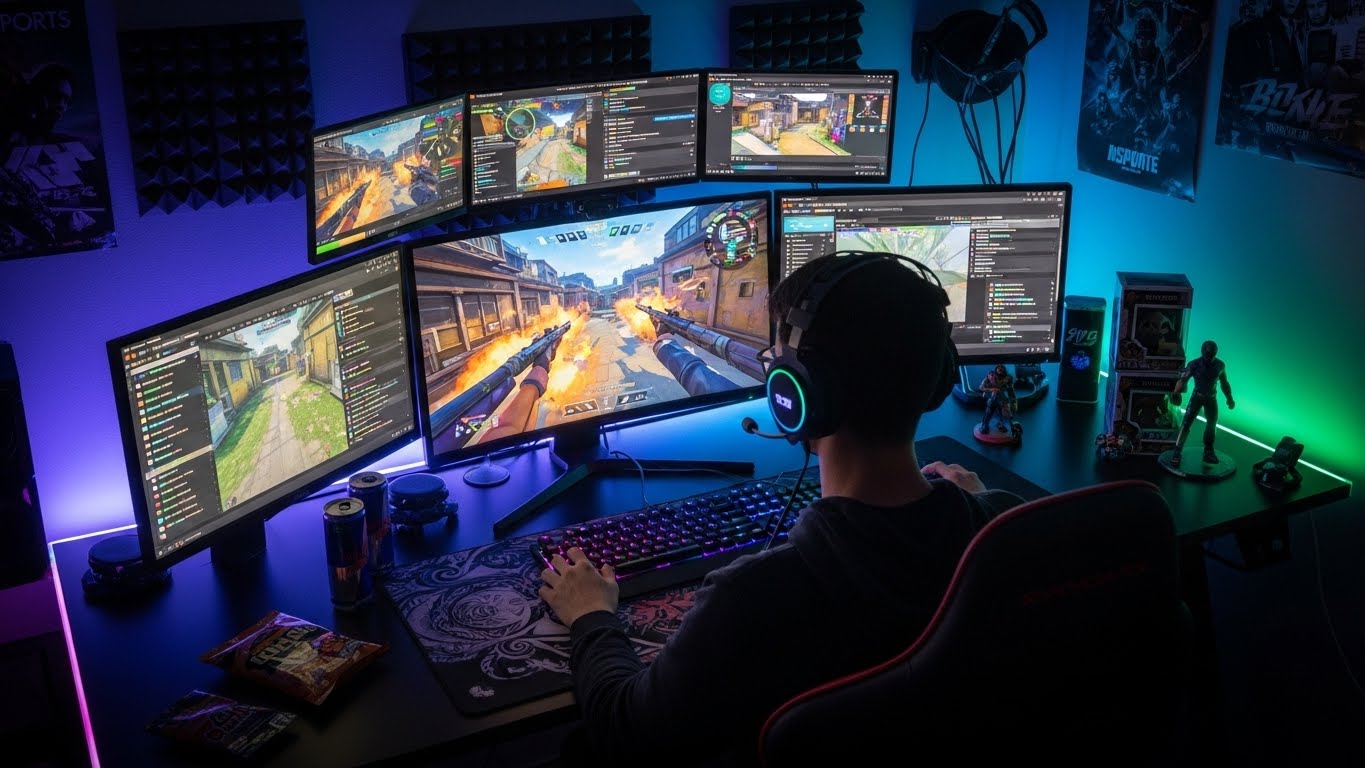

Gaming has evolved from a niche hobby to a global entertainment industry that captivates millions of players across the world. From the pixelated screens of early arcade games to the highly immersive virtual worlds of modern-day gaming, the industry has seen immense growth and innovation. With advancements in technology, gaming has transformed not only in terms of visuals and gameplay but also in its cultural and social significance.
This blog post explores the fascinating journey of gaming, its technological evolution, and its impact on society. Let’s dive into how gaming has become a key part of modern culture and its future direction.
The Early Days of Gaming
In the early days, video games were relatively simple, both in design and gameplay. The first commercially successful video game, Pong, was released in 1972 by Atari, offering a basic simulation of table tennis. This marked the beginning of the video game industry. It was a simple concept, but it had an immense impact on entertainment. Arcade machines became popular in the 1970s and 1980s, offering games like Space Invaders and Pac-Man that drew huge crowds and defined an era.
The gaming world in these early years was limited by the technology of the time. Consoles and arcade machines had restricted memory and processing power, which meant that games were often straightforward and based on a single concept. Players would insert coins into arcade machines to play games, with the objective of achieving the highest score possible.
The Birth of Home Consoles
In the mid-1970s, home consoles began to emerge, allowing people to play video games in the comfort of their own homes. The Atari 2600, released in 1977, became one of the first successful home consoles, giving rise to a new era of gaming. The home console market grew rapidly throughout the 1980s and early 1990s, with iconic systems such as the Nintendo Entertainment System (NES), Sega Genesis, and Super Nintendo Entertainment System (SNES) shaping the industry.
These consoles introduced more complex games, with better graphics, sound, and storytelling. Popular franchises like Super Mario, The Legend of Zelda, and Sonic the Hedgehog emerged during this time, establishing themselves as key pillars in the gaming world. These games were not just about high scores anymore; they started telling stories and offering players more complex, engaging experiences.
The Rise of 3D Graphics and Open-World Games
The 1990s and early 2000s marked a major turning point in the world of gaming with the introduction of 3D graphics. The Sony PlayStation, released in 1994, became a game-changer in the industry by allowing developers to create games with three-dimensional worlds. This technological leap unlocked new possibilities for immersive gameplay and realistic graphics.
Games like Final Fantasy VII, Metal Gear Solid, and Gran Turismo showcased the power of 3D graphics and set new standards for game design. The ability to explore virtual environments from multiple angles made the gaming experience far more immersive and engaging. The transition from 2D to 3D also allowed for more complex game mechanics, including open-world exploration.
One of the most influential games of this era was The Legend of Zelda: Ocarina of Time, which set a new benchmark for open-world games. It gave players the freedom to explore vast landscapes, solve puzzles, and engage in deep storytelling. Open-world games became a genre of their own, with later titles like Grand Theft Auto III, The Elder Scrolls V: Skyrim, and Red Dead Redemption offering sprawling, interactive worlds where players could choose their path and make decisions that affected the game’s narrative.
Online Gaming and Multiplayer Experiences
As the internet became more widespread, gaming also shifted toward online connectivity, allowing players to engage in multiplayer experiences from around the world. The early 2000s saw the rise of MMOs (Massively Multiplayer Online games) such as World of Warcraft and EverQuest, where thousands of players could interact with each other in a shared virtual world. These games created online communities and established a new form of social interaction, allowing players to form friendships, join guilds, and compete in large-scale battles.
Online gaming also led to the rise of competitive esports, which has grown into a multi-billion-dollar industry. Games like League of Legends, Dota 2, and Counter-Strike: Global Offensive have made professional gaming a legitimate career path, with players competing for large cash prizes and sponsorships. The rise of streaming platforms like Twitch has further fueled the popularity of competitive gaming, giving players the ability to share their gameplay with a global audience.
The Impact of Mobile Gaming
With the advent of smartphones, gaming became even more accessible. Mobile gaming has exploded in popularity over the past decade, allowing people to play games anywhere and anytime. From simple puzzle games like Candy Crush Saga to more complex titles like Clash of Clans and PUBG Mobile, mobile games offer a diverse range of experiences for players of all ages.
Mobile gaming has democratized gaming, enabling a broader audience to experience the joys of interactive entertainment. Casual gaming, in particular, has become a major trend, where players can pick up a game for a few minutes during their commute or while waiting for an appointment. The simplicity and accessibility of mobile games have also made them a popular choice for younger players and those who may not traditionally consider themselves gamers.
Virtual Reality (VR) and Augmented Reality (AR)
In recent years, virtual reality (VR) and augmented reality (AR) have started to push the boundaries of what’s possible in gaming. VR technology, which immerses players in a completely virtual world using a headset, offers an unprecedented level of immersion. Games like Beat Saber, Half-Life: Alyx, and The Walking Dead: Saints & Sinners have demonstrated the potential of VR gaming, allowing players to interact with the environment in ways that were previously unimaginable.
Similarly, AR games like Pokémon GO have brought the real world and virtual elements together, encouraging players to explore their surroundings while interacting with virtual characters and objects. The success of Pokémon GO highlighted the potential for AR to transform gaming into an experience that blends physical and digital realities.
While VR and AR are still in their early stages, they have already begun to change the way we think about gaming. As the technology improves and becomes more affordable, it’s likely that these immersive experiences will play an even larger role in the future of gaming.
The Social and Cultural Impact of Gaming
Gaming is no longer just a solitary activity or a pastime reserved for a niche group of enthusiasts. It has become a global social activity that brings people together across cultures and borders. Multiplayer games, both online and offline, allow players to connect with friends and strangers from all around the world, forming communities that transcend geographic boundaries.
Furthermore, games have become a form of storytelling and artistic expression. Titles like The Last of Us, Journey, and Red Dead Redemption 2 have demonstrated the potential for games to tell deeply emotional and thought-provoking stories. As gaming has matured as a medium, it has garnered recognition as an art form, with developers creating experiences that rival the best in film and literature.
Games have also served as a platform for social commentary, exploring important themes such as identity, morality, and politics. Games like Spec Ops: The Line and Papers, Please have tackled issues such as war, totalitarianism, and the human condition, prompting players to reflect on their actions and choices within the game world.
The Future of Gaming: What Lies Ahead?
Looking to the future, the gaming industry is poised for even greater transformations. As technology continues to advance, we can expect to see even more realistic graphics, more immersive virtual environments, and more interactive experiences. The rise of cloud gaming is also set to revolutionize how we play games, allowing players to access high-quality games without the need for expensive hardware.
AI-driven game development is another exciting frontier. With advancements in machine learning, developers are exploring ways to create more dynamic and intelligent NPCs (non-playable characters) that can react to players’ actions in realistic ways, creating more immersive and unpredictable experiences.
Additionally, as gaming continues to integrate with other forms of media, we may see even more crossovers between video games, movies, and TV shows. With the success of game-based TV series like The Witcher and Castlevania, the lines between traditional forms of entertainment and gaming are becoming increasingly blurred.
Conclusion
Gaming has come a long way since its humble beginnings, and its evolution shows no signs of slowing down. From the pixelated arcade machines of the past to the immersive virtual worlds of the present, gaming has become a central part of modern culture. Whether you’re a casual player or a hardcore enthusiast, the world of gaming offers something for everyone. As technology continues to evolve, it’s clear that the future of gaming is brighter than ever, and we’re only just beginning to scratch the surface of what’s possible.
The journey of gaming from its early days to its current state has been nothing short of extraordinary, and it’s exciting to think about where it will take us next. So, what’s your next adventure going to be? Whether it’s in the form of a new console, a VR headset, or an immersive MMO, the world of gaming has endless possibilities awaiting your exploration.